




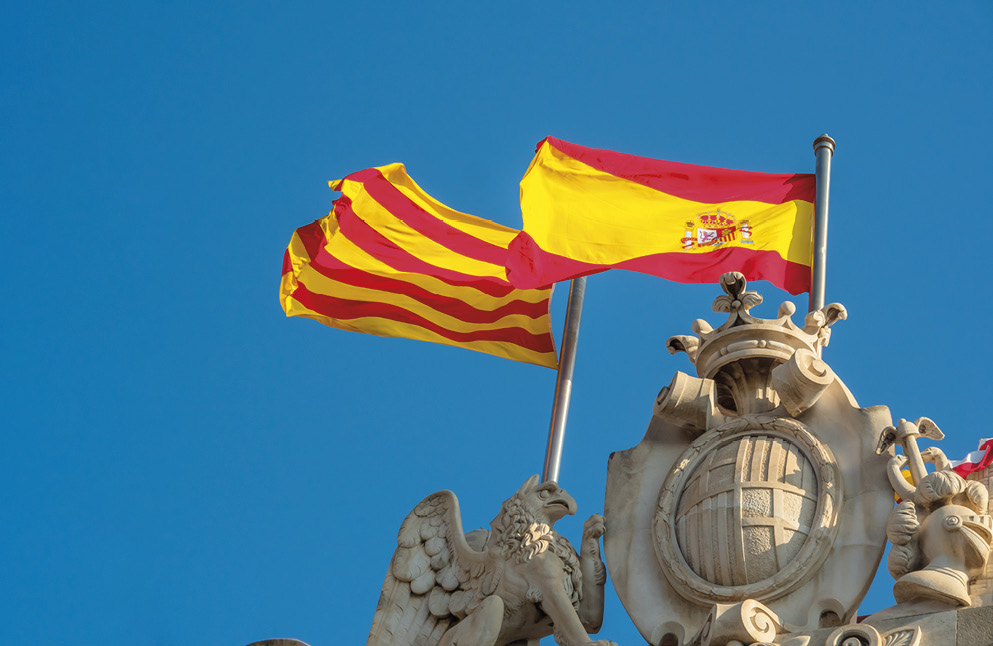
Bozen – The Catalan conflict divided Catalan society between supporters and opponents of independence. In the rest of Spain, the independence process generated a worrying adverse reaction, reinforcing the traditional idea of Spain. The secessionist crisis has also fostered intense polarization of politics and party competition, seemingly making political compromise a mission impossible.
On the one side, there are nationwide parties (such as PSOE or PP), often called “constitutionalist” political forces which nevertheless maintain opposing views of the Catalan conflict. On the other side are the “pro-independence” or “pro-sovereignty” groups, both in Catalonia and in other “historic nationalities”, including in the Basque Country.
The Catalan conflict divided Catalan society between supporters and opponents of independence.
The procès – the term attached to the developments surrounding the ‘right to decide’ on Catalonia’s constitutional future – also incorporated an important judicial aspect, since a number of independentist leaders (those who did not flee Spain) were arrested, prosecuted and convicted for the crimes of sedition and embezzlement of public funds. The trial before the Supreme Court added an important element of tension not only in the political arena but also among a broad sector of Catalan society which, even when not favouring independence, expressed its rejection of the criminal proceedings against the pro-independence leaders.
Certainly, the central government’s decision to pardon those convicted after they had served several years in prison had a politically soothing effect, substantially reducing the conflict inherent to this dimension of the conflict. The judicial front, however, is not definitively closed. Carles Puigdemont, the former president of Catalonia presiding over the 2017 referendum, as well as other members of his government who fled Spain, would likely face trial if they were to return, and many other less notable figures continue to face prosecution.
The case Puigdemont
The disruptive effects of these developments are far-reaching and can be seen in the vicissitudes of the case in the courts at the European level. The various European arrest warrants issued by the Spanish Supreme Court for the surrender of the fugitive leaders led, after the last refusal, to the submission of a preliminary question to the Court of Luxembourg. The European Parliament had to recognize Mr. Puigdemont’s status as an MEP in application of the decision of the CJEU in the Junqueras case. In that case, the Court ruled that a person elected to the European Parliament acquires the status of MEP at the time of the official declaration of the results and enjoys, from that time, the immunities attached to that status.
However, Puigdemont’s immunity was waived by the EP after having received the request presented by the Spanish Supreme Court, a decision that has been appealed before the CJEU. In terms of domestic politics, the situation of the former president casts an important shadow of tension over the current government of Catalonia, made up of a coalition of two pro-independence parties, one of which is still led by Puigdemont.
A complex panorama
We are faced, then, with an extraordinarily complex panorama which, as indicated above, presents significantly lower levels of tension compared to those existing at the peak stage of the conflict, but which still calls for responses from the Spanish political-institutional system. In this sense, the secessionist crisis of 2017 reawakened an issue with long historical trajectory – the fit of Catalonia within Spain. This lay dormant for several decades in the framework of a successful process of decentralization, but has now re-emerged with a vengeance. Getting out of this intricate labyrinth, therefore, is an arduous matter that requires a good deal of commitment and skill by the parties involved.
Assuming that it is not possible to wish away the desire for independence, which continues to enjoy considerable support in Catalan society, the Spanish government has brought the issue of Catalonia’s status to a “dialogue table” – a bilateral forum created to foster discussions between the Spanish and Catalan governments. Though the forum was convened only twice in a year and a half, the very fact that the dialogue commenced is in itself an achievement. This overture recovers the value of politics, an element that was missing in the secessionist crisis, when the only argument put forward by the central Executive was the principle of legality.
Achieve a better accommodation of Catalonia within Spain
In line with this principle, we must draw attention to the legal path that can develop the forum for dialogue, since the Constitution is the frame of reference that delimits its action. What should be emphasized is that, beyond a hypothetical (and politically impossible) constitutional reform, there are spaces to achieve a better accommodation of Catalonia within Spain.
This is the case with the system of autonomous financing, which has not been renewed for more than a decade. In its current configuration, it does not respond to reality and clearly penalizes the interests of some Autonomous Communities, including especially Catalonia.
Regarding the distribution of powers, the Constitutional Court’s ruling 31/2010 declared certain provisions of the Catalan Statute unconstitutional on formal grounds. This included, for example, the regulation of the Autonomous Communities’ participation in EU affairs. Although the Court noted that the Statute of Autonomy was not the appropriate route for such changes, a fertile space can open up to recover some of these provisions in other forms. Likewise, although with an eminently symbolic value, the implementation of a process of deconcentration of institutional headquarters, currently located in Madrid, could be considered, taking them to other territories, including Catalonia.
As far as the Catalan pro-independence forces are concerned, especially those with government responsibilities within the Generalitat (the Catalan government), a substantial degree of realism is needed. Opinion polls indicate that they do not have the backing of a clear majority of Catalans to pursue the rupture with Spain. While adhering to the mantra of the right to self-determination and amnesty for the “political” prisoners of the procès, Esquerra Republicana, currently the largest pro-independence party in government, agreed to be part of the dialogue forum with the Spanish government. This in no way guarantees that the dialogue will result in substantial progress. Even so, these are hopeful steps toward reconciliation.
Ana María Carmona Contreras
 THE ARTICLE was first published on the Science Blog EUreka! of Eurac Research (https://www.eurac.edu/en/blogs/eureka).
THE AUTHOR is Professor of Constitutional Law at the University of Seville.
Info
Glossary
sedition: Aufruhr, Aufwiegelung
embezzlement: Untreue
vicissitudes: Unbeständigkeit, Wandel, Launen
to waive sth.: etw. erlassen, auf etw. verzichten, etw. aufgeben
vengeance: Rache, Vergeltung
arduous: anstrengend, beschwerlich, mühsam
to convene: sich versammeln, zusammenkommen